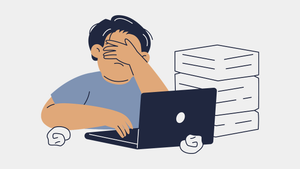
Many of us chalk up creative blocks to a lack of inspiration or skills. But in reality, it’s not usually about creativity at all. It’s about something much harder to identify, but easier to control. Creative blocks are often a symptom of insufficient groundwork, a lack of understanding. As designers, constraints are part of our work. Time is almost always one of those constraints. And we are likely to experience what feels like a creative block when we rush to solutions before fully grasping the problem because we’re short on time or think we know the answer.
This approach can have dire, but avoidable consequences.
We can get stuck in cycles of guesswork and endless tweaking. This can lead to growing frustration that feels like a creative block. The solution isn’t to push through, but to build a strong foundation of understanding. When you do this, solutions will naturally emerge.
Creative blocks are usually the result of upstream failures.
We are all familiar with the feeling.
Not knowing or having enough information can leave us feeling like we’re poking around in the dark. Like, we can’t quite figure out how to move forward. When this happens, one of the best things to do is go back to the basics.
The action bias: why we jump to solution mode
We often dive into design work too quickly, thanks to a psychological tendency known as action bias. Especially in high-pressure settings. We feel compelled to “do something” immediately, rather than taking the time to pause and think things through.
- The illusion of progress: Putting a layout on the screen feels like real work, while time spent researching or thinking doesn’t, especially to our stakeholders.
- Easing anxiety: Uncertainty is uncomfortable. Jumping straight to solutions makes us feel better. It gives us a false sense of control and temporary relief from the discomfort of not having all the answers.
- The “expert” trap: Even seasoned designers can fall into “pattern matching.” Assuming they’ve seen this problem before and reaching for familiar solutions. This can lead to going on autopilot, applying old answers to new challenges without checking if they truly fit.
Albert Einstein once said that if he had an hour to solve a problem, he would spend 55 minutes understanding it. Then he would take five minutes to come up with solutions. In the modern workplace, we often do the opposite. This creates the “tinkering trap.” It happens when people make endless small adjustments, but experience no real progress or breakthroughs.
Creativity follows understanding
Research highlights that deep understanding is a critical factor for creativity. Creative blocks often happen when we lack information, research, empathy or haven’t spent enough time listening. It’s almost impossible to find a solution without fully understanding the problem. Skipping discovery often leaves designers “working blind.”
The high cost of the “order taker” persona
We establish ourselves as experts by asking the right questions early in the process. And by guiding the team and process. Without that curiosity and initiative, we risk losing our role as strategic partners and instead becoming “order takers,” simply following instructions rather than guiding and facilitating. This shift can lead to a specific kind of creative block, fueled by friction with stakeholders. Endless iterations aren’t usually a design issue, but a briefing issue. When our briefs are incomplete, nonexistent, or lack clarity, it can result in late-stage discovery work and repeated rounds of feedback.
Internal and external hurdles
Creative blocks don’t come from one source. They can emerge from a combination of internal strain and external pressure.
Internally, we can struggle with things like cognitive overload, imposter syndrome, and value misalignment. When a project feels meaningless, misaligned with personal values, or mentally overwhelming, creativity is elusive because of emotional and cognitive friction.
Externally, the environment matters just as much. Tight deadlines, high-stress cultures, isolation, and rigid organisational constraints all restrict creative movement. In regulated industries like finance, strict rules can distance designers from a real understanding of users, making creative work feel abstract, disconnected, and mechanically executed rather than meaningful.
In both cases, the block isn’t artistic. It’s structural.
The discovery phase: a necessary step
When pressure mounts, teams default to “just start designing.” Discovery is seen as a luxury rather than a necessity. But this is where many problems begin, and creative blocks are born.
Skipping discovery doesn’t save time; it simply delays clarity. It replaces finding the right path with guesswork, leading to frustration, endless revisions, and a sense of being stuck. In professional settings, creative block often shows up as dissatisfaction with the work, not because the designer lacks ideas, but because the work lacks meaning, grounding, and context.
The solution is not more effort. It’s a step back.
Stepping back into research, reframing the problem, and reconnecting with the work’s real context restores creative momentum. Discovery doesn’t slow progress. It’s quite the opposite. Discovery prevents misdirection and future time spent spinning our wheels. Rooting ourselves in understanding creates clarity and freedom.
The role of mindfulness in creativity
If discovery provides the external map, mindfulness provides the internal clarity to navigate it. Many people associate mindfullness with meditation, but mindfulness is a tool that helps us in all areas of life.
Mindfulness allows us awareness. It pulls designers out of autopilot and back into the present. It allows us to stay open, attentive, and mentally flexible instead of reactive and habitual.
This is where creativity reactivates, not through inspiration, but through a clear mind, attention, and perception. Here are a few ways mindfulness helps:
- Decluttering the mind and managing stress: A primary trigger for creative blocks is cognitive overload. A designer cannot think creatively when they feel unfocused or overwhelmed. Mindfulness helps regulate attention. It shifts focus away from spiralling thoughts like “I can’t do this,” and back to the actual details of the problem. This mental clarity creates space for creativity to re-emerge.
- Shifting from ego to purpose: Creative blocks often arise when designers fixate on personal taste or the pressure to create a “portfolio piece.” This ego-driven focus creates friction and unrealistic expectations. Mindfulness helps redirect attention away from self-judgment and back to the purpose of solving real user problems.
- Strengthening empathy and listening: Empathy requires presence. You cannot understand users while mentally rushing, judging, or multitasking. Mindful listening helps designers hear what isn’t explicitly said in briefs and interviews. This prevents the “working blind” feeling that leads to blocks later in the project.
- Increasing task enjoyment through perspective: We often feel blocked because we are bored, and we are bored because we have stopped being curious. Mindfulness reframes routine work by encouraging close attention and curiosity. Designers begin noticing “novel distinctions” in familiar problems, which restores interest, flexibility, and engagement, even in unglamorous industries or repetitive layouts.
- Facilitating flexible thinking: At its core, mindfulness is the ability to shift perspective. A mindless state operates on autopilot, trapped in rigid categories and the assumption that we already know the answer. A mindful state stays open to the specific context of the moment. This ability to see a problem with fresh eyes is what allows designers to solve complex, high-stakes problems without getting stuck in old patterns.
Creative blocks are not a personal failure
Creative blocks don’t mean you’ve lost your spark. They’re just a sign that something important is missing. Maybe it’s a lack of understanding, a need for more structure, or simply not enough space to think. It’s not about a lack of talent or inspiration. More often, creative blocks show up when we rush through the thinking, don’t have enough context, or try to solve problems that haven’t been clearly defined. The real magic happens when we stop blaming ourselves and start seeing it as a system issue. Instead of forcing ourselves to push through, we can step back and focus on regaining clarity. We don’t need to force creativity; it will emerge in the right conditions.