The Danger of Art
As designers—especially product designers—we may not consider ourselves artists. Our work is often grounded in systems, logic, and solving practical problems. But we are creative problem solvers, and there’s a phrase we should all embrace, no matter how technical our craft may be.
The acclaimed artist, poet, and writing teacher Jack Grapes suggests you write down a simple mission statement and hang it in your room to look at every single day:
“Art is fraught with danger!”
It’s a stark reminder that playing it safe and relying on what you already know is the enemy of truly great work.
This inherent danger of creation speaks to a profound philosophical difference between talent and genius—a subject that has fascinated thinkers for centuries. Philosopher Arthur Schopenhauer captured this core distinction when he wrote:
“Talent is like the marksman who hits a target which others cannot reach; genius is like the marksman who hits a target which others cannot even see.”
This isn’t simply a matter of having more or less ability; it’s about two fundamentally different ways of thinking and approaching problems.
Talent operates safely within established paradigms. It relies on mastering existing domains, perfecting known methods, and refining ideas that are already understood. A talented creator can hit a difficult target, but they’re still aiming at a target that’s known and visible.
Genius, on the other hand, achieves what others can’t even imagine. It doesn’t just improve on what exists; it transforms or creates it. True genius means venturing into unexplored territory with wild imagination, creating revolutionary work that rewrites the rules and reshapes our understanding of reality.
To reach that kind of greatness, you can’t cling to the safe harbor of your talent; you have to step into dangerous, unknown places where the targets are invisible.
The trap of your own talent
According to Grapes, the relationship between a creator and their talent is often like a mutually beneficial, but ultimately limiting, business transaction. We make an unspoken deal with our abilities:
“Make me look good, and I’ll keep you on the payroll,”
And our talent agrees to the terms. Because talent is reliable and will consistently produce “good” work, it’s incredibly tempting to lean on it.
But that’s exactly why your own talent can become the biggest obstacle to achieving true greatness.
This counterintuitive idea is strongly supported by recent psychological research, which reveals a fascinating paradox: the very skills that fuel your success can eventually become a safe harbor that constrains you from making a real creative breakthrough. A 2026 study on creativity found that while individuals and organizations love to champion innovation, they often suppress the risky behaviors required to achieve it, instead relying on proven methods.
By constantly depending on your talent to keep you safe and make you look good, you actually prevent your true genius, which is needed for “great” work, from ever coming through.
To escape this trap, you have to master the art of “unlearning.” Innovation increasingly demands that you consciously abandon the outdated knowledge and mental frameworks that once gave you an edge, but now block fresh thinking. Your accumulated expertise can actually distort your judgment if you’re unable to let it go.
If you want to move beyond merely “good” work, you must be willing to break the comfortable deal you made with your talent, let go of the skills that make you feel safe, and operate without a net.
Chasing the “Accidents of Genius”
If you can’t rely on your talent to achieve greatness, how do you actually reach it?
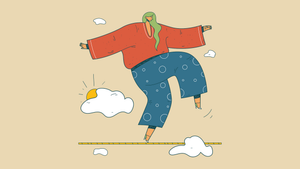
According to Grapes, you can’t force greatness with a formula; you can only chase what he calls the “accidents of genius.” These moments only happen when you step fully into the unknown and abandon the safety of your skills. Grapes compares this terrifying process to “falling off a cliff.”
When you intentionally put yourself in danger, out of your depth, and reach a point where your talent can’t save you, your genius finally wakes up and comes to your rescue.
You’ve probably experienced an accident of genius before. It’s that profound moment when you step back from a piece of writing, a painting, or a design, realize it’s utterly amazing, and immediately ask yourself:
“Where did that come from?”
Because you didn’t rely on your predictable talent, you genuinely have no idea how you created it. Inevitably, your next question is:
“How can I do that again?”
The frustrating reality is that you can’t simply command it to happen; you can only make yourself receptive by repeatedly venturing into the unknown and letting go of your talent.
The necessity of struggling in the unknown is echoed by author Robert Greene’s research on mastery. Greene noticed that great creators begin projects with excitement and deep focus, but inevitably hit a wall of frustration when they spot flaws in their original vision.
While lesser artists might give up or settle for a mediocre, half-realized project, true masters push forward.
They understand, sometimes unconsciously, that this period of frustration and inadequacy is a necessary catalyst for a creative breakthrough.
Grapes encapsulates this dynamic with a piece of wisdom he once found in a fortune cookie:
“Talent does what it can, genius does what it must.”
Your talent is inherently limited and will only ever do what it can do comfortably. But when you’ve exhausted your abilities, put yourself in trouble, and are free-falling off a creative cliff, your genius does what it must to catch you.
Conclusion: The paradox of mastery
While it’s essential to let go of your talent to achieve true greatness, there’s a crucial paradox at the heart of this philosophy: you can’t simply reject mastery from day one.
Breakthrough innovation doesn’t come from lacking skills; instead, it requires you to first relentlessly copy, master, and internalize existing frameworks. Research across art, science, and patents shows that a consistent 5–10 year “mastery window” is needed before true breakthroughs occur. Achieving this initial mastery frees up the mental bandwidth necessary to make genuine creative leaps.
Simply put, you have to fully develop your talent before you can transcend it.
Once you’ve spent years developing your talent, risked failure, and finally captured an “accident of genius,” the real work begins. Grapes compares a finished piece of art or writing to a “machine” you might buy at a hardware store. Even if you’ve captured a moment of genius, you might “plug it in” and find it doesn’t quite work for your audience.
That’s when you put on your editor’s hat and tinker with the parts. If a concept or image isn’t clear, there’s no emotional payoff for the reader, so you have to figure out what to add, cut, or move to make the “machine” work.
Ultimately, Grapes reminds us of the old adage:
“Writing is rewriting.”
Even the greatest artists don’t create perfect first drafts. To reach your highest creative potential, you need the courage to step into the unknown and free-fall until your genius catches you. But once you land, you still need the patience and discipline to tinker with the resulting “machine” until it astounds your audience.